We do not supply prescription lenses. Optical frames ship with plain demo lenses for your optician to replace. Screen glasses and readers are plano or single-power lenses with no prescription in them. Nothing here is an eye test or a substitute for one.
At a glance
| Lens | Found on | Power | What it does | What it does not do |
|---|---|---|---|---|
| Plain demo lens | Optical frames | None (plano) | Shows the shape; gives the optician a template | Correct anything |
| Screen filter lens | Screen glasses | None (plano) | Cuts reflections, filters part of the blue spectrum | Change anything about your eyes |
| Reading lens, +1.0 to +3.0 | Readers | +1.0 to +3.0 | Magnifies close print | Replace an eye test or a prescription |
| Sun lens, grey | Sun | None (plano) | Darkens, blocks UV to 400 nm | Suit night driving or snow |
| Sun lens, brown | Sun | None (plano) | Darkens, blocks UV to 400 nm | Suit night driving or snow |
Demo lenses
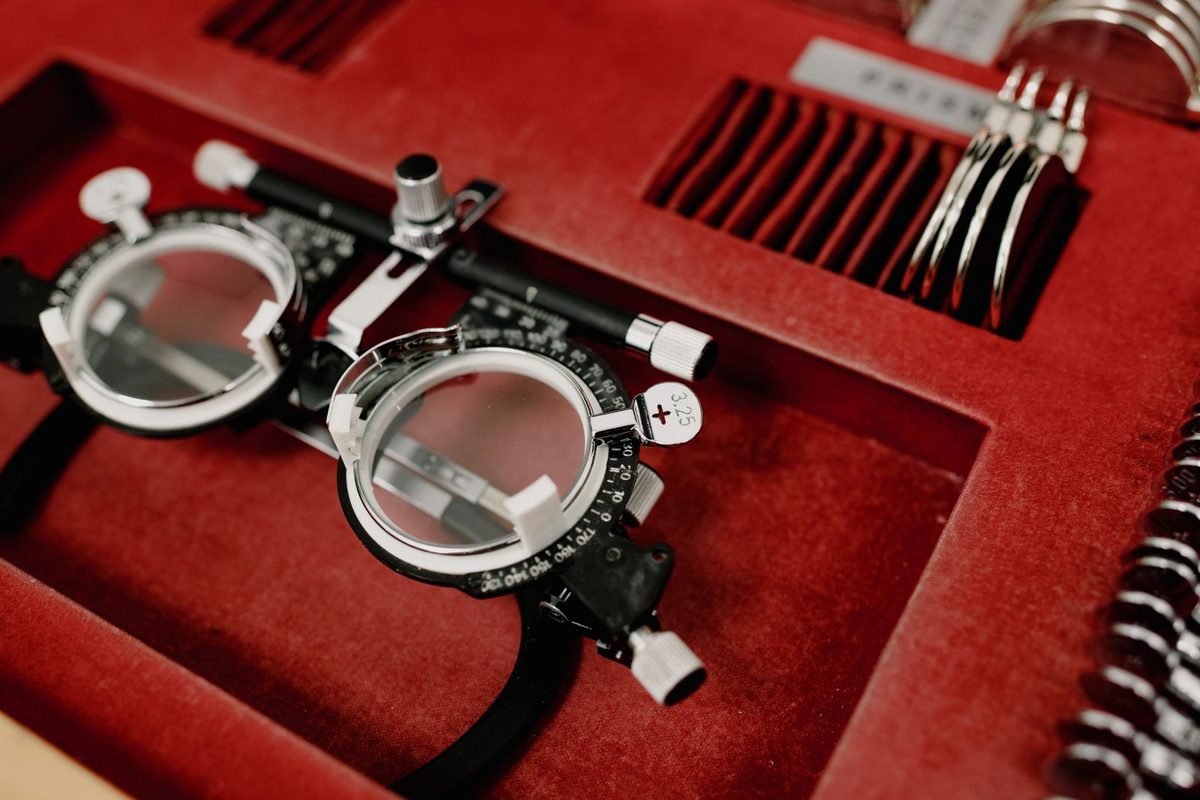
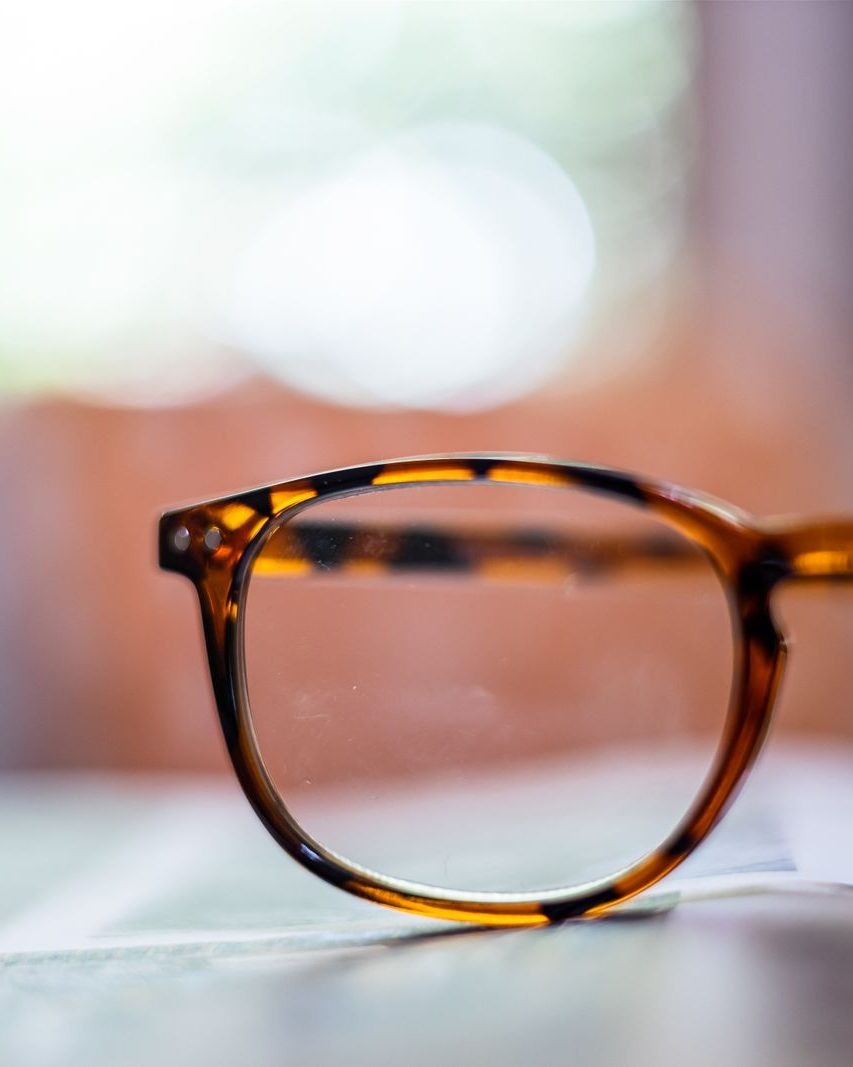
Every optical frame arrives with a pair of clear 2 mm CR-39 lenses cut to the exact shape of the frame. They have no power. They are there so the frame holds its shape in the box, so you can see it on your face, and so your optician can trace the shape when cutting your prescription – which is why we ask you to leave them in until you get there.
What to tell the optician: the frame is a standard full-rim (or half-rim, which needs a grooved lens at least 1.8 mm thick at the edge; or a slight wrap, on the rectangular sunglasses). If they want the shape as a file, the groove depth or the base curve, ask us. Strong prescriptions on a large lens – above about −4.00 on the 54 mm soft square – will show a thick edge; ask about a higher-index lens.
Screen-filter lenses
A plano polycarbonate lens with two things on it: a multi-layer anti-reflective coating, and a filter that absorbs part of the blue end of the visible spectrum. The honest description of what you get is less glare bouncing off a monitor and fewer reflections of the room behind you, which some people find more comfortable over a long evening.
What we will not say: anything about eye health, strain, headaches or sleep. The evidence for those claims is thin and we are not going to pretend otherwise. If your eyes hurt at a screen, see an optician; it may be an uncorrected prescription, and a filter will not fix that.
Two practical notes. The filter leaves a faint yellow cast, visible against white paper and forgotten in an hour. And anti-reflective coatings show skin oil more than bare plastic because there is no reflection to hide it – rinse, a drop of washing-up liquid, dry with the cloth, and never a dry wipe.
Ready-reader lenses
An aspheric, hard-coated CR-39 lens in one of five powers: +1.0, +1.5, +2.0, +2.5, +3.0. Both lenses are the same power and the optical centres are set for an average distance between the pupils. For many people over forty that is enough to read a menu or a phone.
For others it is not, and these are the cases: your eyes need different powers; you have astigmatism; your pupils are unusually close or wide; or you have never had an eye test and are reaching for readers because something has changed. In all of those an optician’s prescription pair will be more comfortable, and in the last one the test matters more than the glasses. Ready readers are not a substitute for an eye test.
Picking a power: if you own a pair that works, order the same. If not, the product page gives a rough starting point by age. If in doubt go lower, not higher – too strong a reader forces you to hold things close.
Sun lenses
Nylon lenses, category 3 (the everyday strength, transmitting roughly 8–18% of light), UV400, in grey or brown. Grey is neutral: colours look the same, only darker. Brown warms the view and lifts contrast on grey days, which some people love and some do not. UV400 means ultraviolet is blocked up to 400 nm, which every lens we sell does and which has nothing to do with how dark it looks.
Not for: driving into low sun (category 3 is fine for driving generally, but no lens fixes a sun on the horizon), snow or glacier (that is category 4, which we do not sell), or night driving. Nylon scratches more easily than glass; rinse off sand before you wipe. None of our sun lenses carries a logo or an etched mark.
Cleaning any of them
- Rinse under lukewarm water to float off grit.
- One drop of washing-up liquid, rubbed gently with fingertips, both sides.
- Rinse again, shake, dry with a clean microfibre cloth.
Never: a dry wipe on a sleeve or tissue, alcohol or window cleaner on acetate or coatings, hot water on acetate. A microfibre cloth washed with fabric softener stops working; wash it without.